
How to Graph Inequalities: Step-by-Step Guide for Beginners
Learn How to Graph Simple Inequalities with Easy Steps!

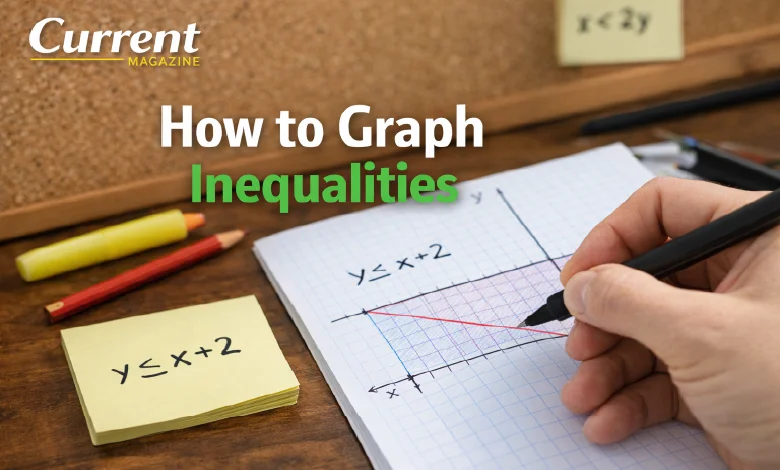
Learning how to graph inequalities is easier than you think. This guide shows you simple steps to graph inequalities on a number line and coordinate plane. We’ll explain what inequalities are, how to read inequality symbols, and how to visualize them correctly.
What Are Inequalities?
An inequality is a math statement that shows two values are not equal. Instead of using an equals sign (=), inequalities use special symbols to show relationships between numbers.
Think of inequalities like comparing sizes. For example, 5 is greater than 3. We write this as 5 > 3. This is an inequality.
Inequalities appear in everyday life:
- Your age is at least 18 to vote
- A box can hold no more than 50 pounds
- A pizza costs less than $20
- You need at least a C grade to pass
Understanding inequalities helps you solve real problems and makes math easier.
Understanding Inequality Symbols
Before you can graph inequalities, you need to know what each symbol means.
Greater Than (>) This symbol means one number is bigger than another. For example, 7 > 4 means “7 is greater than 4.”
Less Than (<) This symbol means one number is smaller than another. For example, 3 < 8 means “3 is less than 8.”
Greater Than or Equal To (≥) This means a number is either bigger OR the same. For example, x ≥ 5 means “x is greater than or equal to 5.” So x could be 5, 6, 7, or any number larger.
Less Than or Equal To (≤) This means a number is either smaller OR the same. For example, y ≤ 10 means “y is less than or equal to 10.” So y could be 10, 9, 8, or any number smaller.
Not Equal To (≠) This symbol means two values are different. For example, x ≠ 3 means “x is not equal to 3.” It could be any number except 3.
How to Graph Inequalities on a Number Line
A number line is the simplest way to show an inequality. It’s a straight line with numbers marked on it.
Step 1: Draw Your Number Line
Draw a horizontal line and mark it with numbers. Include the number from your inequality and a few numbers on either side.
For example, if your inequality is x > 3, draw a number line and mark numbers like 0, 1, 2, 3, 4, 5, 6.
Step 2: Find Your Starting Point
Look at the number in your inequality. This is where you’ll place your first symbol on the number line.
If your inequality is x > 3, find the number 3 on your line.
Step 3: Decide Between Open and Closed Circle
This is important:
Use an Open Circle ( ○ ) for:
- Greater than (>)
- Less than (<)
An open circle means “not including this number.” For x > 3, we don’t include 3 itself, so we use an open circle.
Use a Closed Circle ( ● ) for:
- Greater than or equal to (≥)
- Less than or equal to (≤)
A closed circle means “including this number.” For x ≥ 3, we include 3, so we use a closed circle.
Step 4: Draw the Arrow or Line
For greater than (>) or greater than or equal to (≥): Draw an arrow pointing to the right. This shows all numbers bigger than your starting point.
Example: x > 3 looks like this:
0 1 2 3—○—→
For less than (<) or less than or equal to (≤): Draw an arrow pointing to the left. This shows all numbers smaller than your starting point.
Example: x < 5 looks like this:
←—○—3 4 5 6
Step 5: Check Your Work
Pick a number from your shaded area and plug it into the original inequality. Does it work? If yes, you did it correctly!
For x > 3, pick 4. Is 4 > 3? Yes! ✓
How to Graph Inequalities on a Coordinate Plane
A coordinate plane has two number lines—one horizontal (x-axis) and one vertical (y-axis). This lets you graph more complex inequalities with two variables.
Understanding Two-Variable Inequalities
An inequality like y > 2x + 1 has two variables: x and y. To graph this, you need a coordinate plane.
Step 1: Start with the Boundary Line
First, treat your inequality like an equation. Change the inequality symbol to an equals sign.
For example:
- y > 2x + 1 becomes y = 2x + 1
- y ≤ -x + 3 becomes y = -x + 3
Step 2: Graph the Boundary Line
Graph this equation using the methods you already know. Find the slope and y-intercept if it’s in slope-intercept form (y = mx + b).
For y = 2x + 1:
- The y-intercept is 1 (where the line crosses the y-axis)
- The slope is 2 (rise 2, run 1)
Mark these points and draw your line.
Step 3: Decide: Solid or Dashed Line
Draw a Solid Line ( _____ ) for:
- Greater than or equal to (≥)
- Less than or equal to (≤)
Draw a Dashed Line ( – – – ) for:
- Greater than (>)
- Less than (<)
For y > 2x + 1, use a dashed line because it’s “greater than” (not “equal to”).
Step 4: Shade the Correct Region
Your line divides the plane into two regions. You need to shade the correct side.
For greater than (>) or greater than or equal to (≥): Shade the region ABOVE the line.
For less than (<) or less than or equal to (≤): Shade the region BELOW the line.
Step 5: Test a Point
Pick a point not on the line and test it. A common choice is (0, 0).
For y > 2x + 1:
- Plug in x = 0 and y = 0
- Is 0 > 2(0) + 1?
- Is 0 > 1? NO, this is false.
Since (0, 0) doesn’t work, shade the region that DOESN’T include (0, 0). This confirms you’re shading the right side.
Examples of Graphing Inequalities
Example 1: Simple Number Line Inequality
Graph x ≤ 4
- Draw a number line with 4 marked
- Use a closed circle at 4 (because it includes 4)
- Draw an arrow pointing LEFT (for “less than”)
Result: A number line with a closed circle at 4 and an arrow pointing left.
Example 2: Compound Inequality on a Number Line
Graph 2 < x < 8
This means x is greater than 2 AND less than 8.
- Draw a number line
- Put an open circle at 2
- Put an open circle at 8
- Connect them with a line or shaded area between
This shows all numbers between 2 and 8, not including 2 or 8.
Example 3: Two-Variable Inequality on a Coordinate Plane
Graph y < -x + 2
- Graph the line y = -x + 2 (use a dashed line)
- The y-intercept is 2, slope is -1
- Test point (0, 0): Is 0 < -0 + 2? Is 0 < 2? YES.
- Shade the region that includes (0, 0), which is below the line
The shaded area shows all points that satisfy the inequality.
Common Mistakes to Avoid
Mistake 1: Using the Wrong Symbol Remember: > and ≥ point right on a number line. < and ≤ point left.
Mistake 2: Forgetting to Reverse the Symbol When you multiply or divide an inequality by a negative number, flip the symbol. For example:
- -2x > 6
- Divide by -2: x < -3 (notice the symbol flipped!)
Mistake 3: Shading the Wrong Region Always test a point to make sure you’re shading correctly. The test point method never fails.
Mistake 4: Using the Wrong Circle Type Open circles for > and <. Closed circles for ≥ and ≤. Write this on a note card if you need help remembering!
Mistake 5: Forgetting to Graph the Boundary Line The boundary line (even if dashed) is essential. It shows where the inequality changes.
Tips for Success
Practice with simple inequalities first. Start with number line inequalities before moving to coordinate planes.
Always test your work. Pick a point and check if it satisfies your inequality. This catches mistakes fast.
Use a ruler and pencil. Neat graphs are easier to read and less likely to have errors.
Understand, don’t just memorize. Know WHY you use open circles and why you shade certain regions. This helps you remember.
Color your shaded regions. Using colored pencils makes it clear which area satisfies the inequality.
10 FAQs About Graphing Inequalities
- What’s the difference between > and ≥?
Greater than (>) doesn’t include the number. Greater than or equal to (≥) includes the number. On a graph, use an open circle for > and a closed circle for ≥. - Do I always need a number line to graph an inequality?
No. Number lines work best for simple one-variable inequalities. For inequalities with two variables, use a coordinate plane. Choose the method that fits your problem. - Why do I flip the inequality symbol when multiplying by negative numbers?
When you multiply or divide by a negative, it reverses the relationship. For example, 2 < 5, but -2 > -5. Always flip the symbol when you multiply or divide by a negative number. - How do I know which region to shade on a coordinate plane?
Test a point not on the line. If the point satisfies the inequality, shade the region containing that point. If it doesn’t, shade the other region. - What does a dashed line mean on a coordinate plane?
A dashed line means the boundary is NOT included in the solution. Use dashed lines for > and <. Use solid lines for ≥ and ≤. - Can I graph more than one inequality on the same plane?
Yes! This is called a system of inequalities. Graph each inequality with different colors. The overlapping shaded region shows points that satisfy ALL inequalities. - What’s a compound inequality?
A compound inequality has two parts connected by “and” or “or.” For example, 2 < x < 8 means x is between 2 and 8. Graph both parts and show the overlapping solution. - Why is testing a point important?
Testing a point confirms you shaded the correct region. It’s a quick way to catch mistakes before you finish your work. - Do I need to shade on a number line?
You can shade or use an arrow—both show the same thing. An arrow pointing right means “all numbers to the right.” Shading shows all included numbers. - What if my inequality has fractions like y > 1/2 x + 3?
Graph it the same way! Find the y-intercept (3) and use the slope (1/2) to find other points. The slope means rise 1, run 2. Everything else follows the same steps.
Final Thoughts
Graphing inequalities is a valuable math skill that opens doors to understanding more complex topics. Start with number lines, practice compound inequalities, and then move to coordinate planes. Be patient with yourself—everyone struggles with these concepts at first.