
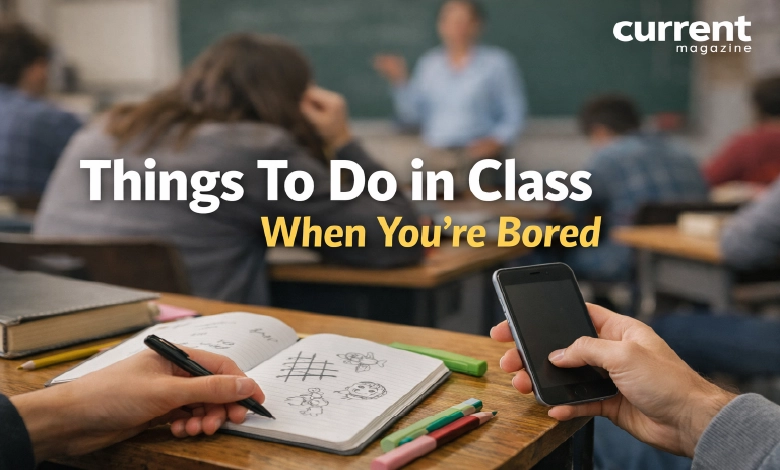
Things to do in class when you’re bored is one of the most searched phrases by students around the world — and honestly, it makes complete sense. Not every class period feels engaging. Not every lecture lands the way a teacher intended. Not every subject lights a fire in every student. And sitting in a chair for 45 minutes to an hour, trying to look attentive when your brain has completely checked out, is one of the most universally shared human experiences of student life.
But here’s the thing: what you do with that boredom matters more than you think. There’s a big difference between using a slow class period productively and doing something that gets you in trouble, embarrasses you, or causes you to miss something important. This guide is going to give you the full picture — creative ways to stay engaged, productive things to do quietly, mental exercises that sharpen your brain, and honest advice about why boredom in class sometimes has a deeper cause worth addressing.
Whether you’re in middle school, high school, or even college, there’s something in here for you.
First: Why Are You Bored in Class?
Before jumping into the list, it’s worth spending a moment understanding where classroom boredom actually comes from. Because the solution isn’t always the same.
Sometimes you’re bored because the material is genuinely too easy for you. Your brain processes it faster than the class moves, and you’re left waiting for everyone else to catch up. This is actually a sign of strength, not laziness — and it means you should be using that extra mental bandwidth productively.
Sometimes you’re bored because the material feels irrelevant. You can’t connect what’s being taught to anything that matters in your real life, so your brain refuses to invest. This is extremely common, especially in required courses that feel disconnected from your goals or interests.
Sometimes boredom is actually anxiety or fatigue wearing a different mask. If you’re sleep-deprived, stressed about something outside of school, or emotionally overwhelmed, your brain will shut down engagement as a protective mechanism. In that case, the best thing to do in class isn’t another activity — it’s to address what’s going on underneath.
And sometimes a class is just taught in a way that doesn’t match how your brain works. You might be a visual learner stuck in a lecture-heavy environment. You might be hands-on and creative in a course built entirely around memorization. That mismatch is real, and it’s not your fault.
Understanding why you’re bored helps you choose the right response. With that said, here are the best things to do when the clock is moving slowly and your brain needs something to work with.
Productive Things to Do in Class When You’re Bored
These are the activities that turn wasted class time into something genuinely useful — so you leave the room better off than when you entered.
Rewrite your notes in a different format. If you’ve been taking standard linear notes, try turning them into a mind map, a diagram, or a set of flashcards. This forces your brain to re-engage with the material from a different angle, which actually improves memory and comprehension. You’re not goofing off — you’re learning more effectively.
Create study questions from what’s being covered. As the teacher talks, write down questions that could appear on a test. “What are the three main causes of X?” or “How does Y relate to Z?” This is one of the most powerful study techniques available — and it keeps your ears and brain tuned in to the lecture while giving your hands something to do.
Write a to-do list for the rest of your day or week. Getting your tasks out of your head and onto paper frees up mental space and reduces background anxiety. Use a slow class period to plan ahead. What homework is due? What tests are coming? What do you need to prepare for?
Work on homework for another class. This is the most obvious one, and it works. If you have an assignment due in your next period, a slow class is a gift. Work quietly and efficiently. Just make sure you’re not missing anything important being said in the room you’re actually sitting in.
Read ahead in your textbook. Getting ahead of the curriculum is one of the best academic advantages you can give yourself. If you know what’s coming, you’ll follow future lessons more easily, ask better questions, and feel more confident during class discussions.
Review and organize your binder or notebook. A disorganized set of notes is almost useless when exam time comes. Use slow class time to date your notes, add headings, highlight key terms, and make sure everything is in order. This small habit can make a dramatic difference during test prep.
Practice writing faster or neater. Set yourself a quiet challenge — write out something you already know from memory, focusing on either speed or legibility. Good handwriting and fast note-taking are genuinely useful academic skills that most students never deliberately practice.
Creative Things to Do in Class When You’re Bored
If your brain truly needs a break from academic content, creative activities are the next best thing. They keep your mind active, develop real skills, and are easy to do quietly without drawing attention.
Draw or sketch in the margins of your notebook. This is as old as school itself — and there’s actually research suggesting that doodling during a lecture can improve information retention by keeping your brain at a low level of engagement rather than fully zoning out. Draw patterns, portraits of the people around you, imaginary landscapes, or abstract designs. Let your hand move and your mind wander slightly.
Write a short story or scene. Pick characters, a setting, and a conflict — and see how far you can get in 20 minutes. You don’t need to finish it. You don’t need it to be good. The act of making something from nothing is one of the best ways to exercise your imagination, and a boring class period is perfect for it.
Design something on paper. A dream bedroom, a house floor plan, a logo, a tattoo concept, a character design, a fashion outfit, a product you wish existed. Designing things on paper develops spatial thinking and creativity, and it looks enough like regular schoolwork that most teachers won’t question it.
Write song lyrics or poetry. You don’t have to be a poet to write poetry. Pick a topic — something you’re feeling, something you observed that day, something completely absurd — and try to express it in a creative form. Rhyming, free verse, haiku — any format works. Writing this way builds vocabulary, emotional intelligence, and expressive range.
Invent a game. Try designing the rules for a simple card game, board game, or word game. Think through how players would win, what decisions they’d make, and how the game would stay balanced and interesting. This is surprisingly complex thinking that pulls on logic, creativity, and systems design simultaneously.
Write letters you’ll never send. Write to a future version of yourself. Write to a public figure whose work you admire. Write to a fictional character. Write to the teacher explaining exactly why this subject needs to be taught differently. These letters don’t need to go anywhere — the writing itself is the point.
Mental Exercises and Brain Games to Do Quietly
These activities sharpen your thinking without requiring any materials beyond a pen and paper — and they’re completely invisible to the people around you.
Try mental math challenges. Pick a number and see how many ways you can make it using addition, subtraction, multiplication, and division. Or calculate how many days old you are, how many hours until the weekend, or how many seconds are in a year. Mental math keeps your brain sharp and genuinely improves numerical reasoning over time.
Play word games in your head. Pick a category — countries, animals, foods, musicians — and go through the alphabet trying to name something in that category for every letter. Or try to think of as many words as possible that contain a specific letter combination. These games are invisible, silent, and genuinely engaging.
Work on logic puzzles. If you have a puzzle book, this is the time for it. If not, construct your own logic problems. Come up with a riddle. Write a lateral thinking puzzle. Try to build a Sudoku grid from scratch. These activities exercise deductive reasoning in ways that directly translate to academic problem-solving.
Practice memorization techniques. Pick something you need to know for a future test — a list of dates, a set of vocabulary words, a formula — and try different memorization methods. Create acronyms. Build a memory palace. Write the information in the form of a story. Turn it into a rhyme. Active memorization beats passive reading by a wide margin.
Think through a problem you’ve been stuck on. Not necessarily a school problem — maybe a social situation you’re navigating, a decision you need to make, or a project you’re planning. Using quiet class time to think clearly, without the distraction of your phone or other noise, can actually produce surprisingly useful insights.
Practice a language you’re learning. Run through vocabulary in your head. Try to construct sentences mentally. Translate the words you’re hearing in class into the language you’re studying. Mentally narrate what’s happening around you in a foreign language. Every minute of passive practice adds up.
Social and Observational Things to Do (Without Being Disruptive)
Sometimes boredom in class is really just a hunger for human connection or stimulation. These activities engage that social curiosity without causing disruption.
People-watch thoughtfully. Look around the room and make up detailed backstories for your classmates. What are they thinking about? Where did they go last weekend? What are they afraid of? What do they dream about? This sounds silly, but it’s actually a form of empathy-building and character development that writers do deliberately.
Observe your teacher as a communicator. Regardless of how boring the content feels, your teacher is a person with a communication style, a set of habits, and a specific way of structuring information. Study how they explain things. Notice what works and what doesn’t. Notice when they use stories or humor to re-engage a room. This kind of observation builds real communication skills.
Write a note to a friend — on paper. Old school, but effective. A handwritten note passed carefully is a low-risk way to connect with someone nearby without using a phone. Keep it brief, keep it positive, and save the deep conversations for outside the classroom.
Make silent predictions. Predict what the teacher is going to say next. Predict what will be on the next test. Predict how the current topic will connect to something you’ve studied before. Actively predicting forces your brain into a participatory mode even when the content isn’t holding your attention.
What NOT to Do When You’re Bored in Class
It’s worth being direct about this. Some common boredom-busters are genuinely bad ideas that come with real costs.
Scrolling your phone is the most tempting option and often the worst one. It’s not just risky if your school has a phone policy — it’s also cognitively damaging during learning time. Every minute spent on social media in class is a minute your brain is being trained to prefer shallow, fast stimulation over sustained focus. That habit has long-term consequences on your attention span.
Sleeping in class feels satisfying in the moment but almost always makes you feel worse afterward — groggier, more confused, further behind, and often embarrassed. If you’re tired enough to fall asleep in class regularly, that’s a sleep schedule problem that needs addressing outside the classroom.
Disrupting others or acting out for entertainment gets you in trouble, damages your relationships with teachers, and makes the class worse for everyone around you. It’s also, frankly, a waste of the social energy you have.
Zoning out completely — just staring blankly and letting time pass — is the worst option of all. It feels neutral but it’s actually costly. You miss information, lose the thread of what’s being taught, and come out the other side with nothing to show for the time.
How to Actually Become Less Bored in Class Over Time
Here’s a perspective shift worth considering: the most sustainable solution to classroom boredom isn’t finding better ways to entertain yourself during class. It’s finding ways to be more genuinely engaged with what’s happening.
That sounds hard — and sometimes it is. But engagement is often a choice before it becomes a feeling. A few small strategies can shift this dramatically.
Sit closer to the front. It sounds simple and it genuinely works. Physical proximity to the teacher makes you more alert, more likely to participate, and less likely to drift. It also signals to the teacher that you’re engaged, which can change how they interact with you.
Ask one question per class. Even if you’re not deeply interested in the material, challenge yourself to find at least one thing that genuinely puzzles you and ask about it. Curiosity, like a muscle, grows with use. The more you practice looking for questions, the more naturally engaged you become.
Connect the material to something you actually care about. This requires some creative thinking, but it’s always possible. History connects to current events. Math connects to money, design, and strategy. Literature connects to human psychology. Biology connects to your own body. Finding the thread between what’s being taught and what you already find interesting changes everything.
Talk to your teacher honestly. If a course consistently feels unchallenging or irrelevant, it’s worth having a private conversation with your teacher about it. A good teacher will appreciate the honesty and may be able to offer advanced work, independent projects, or alternative approaches that make the class feel more worthwhile.
A Final Word on Boredom as a Gift
This might surprise you: boredom is actually valuable. In a world of infinite digital stimulation available at your fingertips at all times, the ability to sit quietly with your own thoughts — to be bored without immediately reaching for a screen — is becoming rare and genuinely important.
Boredom is where creativity is born. It’s where daydreams live. It’s where unexpected connections between ideas get made. The greatest inventors, artists, writers, and thinkers in history were people who spent enormous amounts of time sitting quietly with their thoughts.
So if you’re going to do something with your boredom in class, choose something that keeps your brain working — drawing, writing, thinking, planning, creating. Not something that turns your brain off.
The students who use slow class periods well don’t just survive school. They get ahead of it.
10 FAQs: Things to Do in Class When You’re Bored
Q1. What are the best things to do in class when bored without getting caught?
The safest options are things that look like schoolwork — rewriting notes, working on homework for another class, drawing in your notebook, or writing in a journal. These activities keep you productive and are nearly impossible for a teacher to object to, even if they notice.
Q2. Is it okay to doodle during class?
Yes — and there’s actual research to back this up. A study published in the journal Applied Cognitive Psychology found that doodling during a lecture improved information recall by 29% compared to non-doodlers. Doodling keeps your brain at a mild level of engagement that prevents full zoning out. Just keep it in your notebook and don’t let it become a distraction to others.
Q3. What should I do in class when I already understand everything being taught?
This is a great problem to have. Use the time to go deeper — write more detailed notes, create practice questions, read ahead in the textbook, or work on related homework. You might also consider talking to your teacher about whether you could take on enrichment work or a more advanced version of the material.
Q4. How do I stay awake in a boring class?
Sit near the front, take active notes even if they’re not perfect, drink water, sit up straight, and engage your hands by writing or drawing. If sleepiness is a consistent problem, address your sleep schedule — most teenagers need 8 to 10 hours of sleep per night, and chronic sleep deprivation makes every class feel unbearable regardless of the content.
Q5. Can I use my phone in class when I’m bored?
Most schools have policies against phone use during class, and breaking those rules comes with real consequences. Beyond the policy issue, phone use during class genuinely impairs your ability to absorb information — even passively. If you must use your phone, use it for something educational like reviewing flashcards in an app rather than scrolling social media.
Q6. What are productive things to do in a boring college lecture?
College lectures tend to have more freedom than high school classes, which opens up options. You can work on readings or assignments for other courses, review material from previous lectures, outline upcoming essays, plan your week, or engage in deep note-taking using frameworks like the Cornell Method. Many college students also type notes, which allows you to simultaneously research related concepts online.
Q7. How do I make boring classes more interesting?
Try gamifying your note-taking — predict what the teacher will say and give yourself points for correct predictions. Challenge yourself to ask at least one question per class. Connect the topic to something you genuinely care about. Sit with a friend who keeps you engaged. Reward yourself after class for staying focused. Small mental tricks go a long way toward changing how a class feels.
Q8. What should I never do when bored in class?
Avoid sleeping, scrolling social media, disrupting other students, or completely zoning out. These options feel harmless but carry real costs — missed information, academic consequences, damaged relationships with teachers, and the long-term erosion of your ability to sustain focus. Even the least engaging class is teaching you something if you stay even partially present.
Q9. Is it bad to be bored in class? Does it mean I’m a bad student?
Not at all. Boredom in class is one of the most universal student experiences in the world. It doesn’t reflect your intelligence, your worth, or your potential. It often reflects a mismatch between how you learn and how the class is structured — which is a systems problem, not a personal one. What matters is what you do with the boredom.
Q10. How can I use boring class time to get ahead academically?
Use it to review previous material before it fades from memory, complete homework so your evenings are free, create study guides or flashcards for upcoming tests, read ahead so future lessons feel familiar, or practice skills like writing and mental math. Students who treat every available minute as an opportunity tend to feel far less academic pressure overall — because they’ve been quietly building advantage all along.