
Things to Do When You Have No Internet – Fun, Easy & Smart Ways to Stay Happy Offline

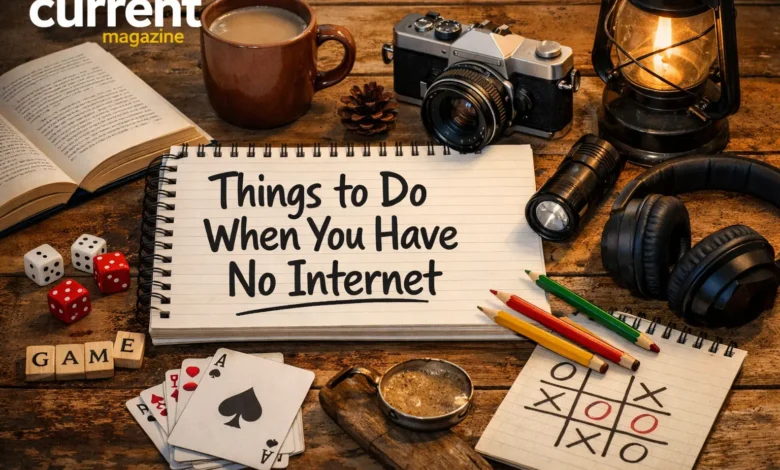
If you’re desperately searching for things to do when you have no internet, chances are you’re already feeling that familiar low-level panic that sets in the moment your WiFi goes down or your data runs out. The router is blinking the wrong color. Your phone says “No Service.” And suddenly the house feels very quiet and your hands don’t know what to do with themselves.
Here’s the truth that most people don’t want to hear: the internet has become so woven into daily life that losing it — even temporarily — genuinely feels disorienting. And that disorientation is worth paying attention to. Because the activities that filled human lives before the internet existed are still available to you right now, today, and many of them are more satisfying than anything a screen can offer.
This guide is your complete resource for what to do when the internet goes out, your data runs out, you’re somewhere with no signal, or you simply want to take a deliberate break from being online. Whether you have an hour or an entire weekend, there is more than enough here to keep you engaged, productive, creative, and genuinely entertained — no WiFi required.
Why Losing the Internet Feels So Hard
Before jumping into activities, it’s worth spending a moment understanding why no internet feels so uncomfortable for most people today.
The internet is not just entertainment. For most people it serves as a communication tool, a work platform, a navigation system, a shopping mall, a bank, a news source, a social life, and an endless source of stimulation all rolled into one. When it disappears, you don’t just lose Netflix. You lose the thing your brain has been trained to reach for dozens or hundreds of times a day whenever you feel bored, anxious, uncertain, or understimulated.
That constant reaching is a habit — a deeply ingrained one. And like all habits, it takes a moment to override. The first thirty minutes without internet are usually the hardest. Your hand keeps moving toward your phone. You keep checking for a signal. You feel restless and slightly irritable without quite knowing why.
Push through that window. Because on the other side of it is something that has become genuinely rare in modern life: the experience of being fully present in your own space, with your own thoughts, with no feed to scroll and no notification to chase. Once you settle into that space, most people find it surprisingly peaceful.
Productive Things to Do When You Have No Internet
1. Deep Clean and Organize Your Home
No internet means no distractions, and no distractions means you can finally tackle the cleaning and organizing tasks that have been sitting on your mental list for months. The kitchen cupboards that need reorganizing. The bathroom cabinet that’s become a chaotic collection of half-empty bottles. The junk drawer that has been a source of mild shame for two years.
Pick one area and give it your complete attention. Take everything out. Clean the surface underneath. Only put back what you actually use. Everything else gets donated, thrown away, or moved to a more logical place.
Deep cleaning and organizing is deeply satisfying in a way that’s hard to explain until you’ve done it. Your environment directly affects your mental state, and a cleaner, more ordered space produces a genuine sense of calm and control. You can’t do this while half-watching YouTube. No internet is actually the perfect condition for it.
2. Read a Physical Book or Magazine
This is the most obvious offline activity and also one of the genuinely best ones. If you have books in your home that you haven’t read — and most people do — now is the time. Pick one up, find a comfortable spot, and give it your full attention.
Reading a physical book without a screen nearby is a qualitatively different experience from reading with your phone within reach. Your attention goes deeper. You get absorbed more completely. Time passes differently. A good book on a quiet afternoon without internet is one of the most restorative experiences available to a human being, and it requires absolutely nothing except the book and your attention.
If you don’t have unread books at home, magazines, newspapers, printed recipes, or even instruction manuals for things you own can fill the gap. The point is engaging your brain with words on a physical page rather than a screen.
3. Write — In Any Form
No internet is a wonderful prompt to write. Get a notebook or open a blank document on your laptop and just start. The options are genuinely endless.
Write in a journal. Write about what’s happening in your life right now — the things that are going well, the things that are worrying you, the things you’re looking forward to. Write a letter to someone you care about, either to send or just to clarify your own feelings. Start a story you’ve been turning over in your mind. Write out your goals for the next six months. Make lists of things you’re grateful for. Write a detailed description of your earliest childhood memory.
Writing without internet is particularly valuable because there’s no temptation to quickly look something up, check social media for a moment, or get distracted by a notification. The page is just you and your thoughts. That quality of uninterrupted reflection is rare and genuinely valuable.
4. Work on Something You’ve Been Putting Off
Think about the tasks in your life that always get pushed to tomorrow because they require sustained attention and today your attention is scattered across seventeen browser tabs. Without internet, many of those tasks suddenly become possible.
Writing a difficult email, working through a complex problem at work, studying material you’ve been avoiding, practicing a skill that requires focus, planning a project from start to finish — all of these benefit enormously from the kind of deep, uninterrupted attention that internet access makes nearly impossible for most people.
Treat your no-internet period as a gift of focus. The work you do in two hours without the internet will often exceed what you accomplish in an entire distracted day with it.
5. Cook or Bake Something From Scratch
Open a physical cookbook — or work from a recipe you already know by heart — and spend time in the kitchen making something that takes real effort. Fresh bread. A soup built from scratch. Homemade pasta. A cake that requires multiple steps and actual attention.
Cooking and baking without being able to quickly look something up forces you to rely on your own knowledge and judgment, which builds real culinary confidence over time. It also produces something tangible and delicious at the end, which is one of the most satisfying possible outcomes of a few hours without WiFi.
The kitchen is a wonderful offline space. It engages multiple senses, requires enough attention to prevent boredom, and rewards your effort in the most immediate and enjoyable way possible — with food.
6. Learn or Practice a Physical Skill
Think about physical skills you have or want to develop that require practice rather than instruction: playing a musical instrument, drawing, calligraphy, knitting, woodworking, juggling, yoga, stretching, martial arts forms, or any kind of craft.
These skills improve through repetition and practice, not through watching videos about them. No internet means no opportunity to procrastinate by watching one more tutorial instead of actually practicing. Pick up the guitar. Sit down at the piano. Get out the sketchbook. Pull out the knitting needles. Practice the thing rather than researching the thing, and notice how much faster your skills develop.
7. Exercise and Move Your Body
Without the internet, your usual excuses for not exercising disappear. You can’t get pulled into one more video, one more scroll, one more episode. You have time and you have your body. That’s all you need.
Go for a run in your neighborhood. Do a bodyweight workout in your living room — push-ups, squats, lunges, planks, and jumping jacks require no equipment and no WiFi. Do yoga using a sequence you already know. Go for a long walk somewhere you find pleasant. Ride your bike. Jump rope in the backyard.
Exercise without screens is also qualitatively different from exercise with them. When you’re not listening to a podcast or watching a video, you’re more present in your body. You notice your breathing, your surroundings, and your physical sensations more fully. Many people find this more restorative than screen-accompanied exercise even though it requires more from you mentally.
Creative Things to Do When You Have No Internet
8. Draw, Sketch, or Paint
You don’t need talent to enjoy drawing. Pick up a pen or pencil and draw what you see in front of you — a plant on the windowsill, the view out your window, the objects on your coffee table, your own hand. Drawing from observation is a meditative practice that slows your perception down and trains you to really look at things rather than just glancing at them.
If representational drawing feels intimidating, try abstract mark-making — just filling a page with shapes, patterns, lines, and textures without trying to make it look like anything. It’s surprisingly absorbing and produces results that often look more interesting than you’d expect.
9. Play a Board Game or Card Game
If you have other people in the house — family members, roommates, a partner — no internet is a perfect prompt to play a board game or card game together. Games that work well with small groups include chess, Scrabble, Monopoly, Catan, Uno, rummy, cribbage, and dozens of others.
Board and card games create a kind of focused, playful social interaction that’s become increasingly rare in households where everyone retreats to their own screen. The conversations that happen around a game table — the banter, the negotiation, the shared laughter — are some of the best social experiences available in a home setting, and they require nothing except the game and the people.
10. Start a Scrapbook or Photo Album
If you have printed photos lying around — or if you’re willing to print some from your phone while you still have data — a scrapbook or photo album is a wonderful offline project. Gather your photos, arrange them chronologically or thematically, and add handwritten notes, captions, or memories alongside them.
Physical photo albums are increasingly rare in the age of cloud storage, which is precisely what makes them valuable. A well-made photo album is an object that people treasure for decades. Working on one without the distraction of the internet means you’ll actually finish it rather than getting halfway through and getting pulled back online.
11. Rearrange Your Furniture
This sounds mundane but it’s genuinely one of the most impactful things you can do with a few free hours at home. Moving furniture around changes the way a room feels completely, and costs absolutely nothing. Push the couch to a different wall. Try your desk facing a different direction. Move the bookshelf to a new spot.
Without internet to distract you, you can actually take the time to try multiple configurations and think carefully about how the space flows and feels. Many people who try this are amazed at how different — and how much better — their home feels after a simple furniture rearrangement.
12. Write Snail Mail Letters
Writing a physical letter to someone and mailing it is one of the most thoughtful and increasingly rare gestures a person can make. Think of someone who would genuinely love to receive a letter — an elderly relative, an old friend you’ve lost touch with, a mentor who made a difference in your life — and write to them.
Tell them what’s been happening in your life. Share a memory of them. Ask questions about theirs. A handwritten letter takes twenty minutes to write and costs less than a dollar to mail, but the impact it has on the person who receives it is genuinely disproportionate to the effort involved. In a world of instant digital communication, a physical letter feels like a rare and meaningful gift.
Relaxing Things to Do When You Have No Internet
13. Meditate or Practice Mindfulness
No internet is actually an ideal condition for meditation. There are no notifications coming in, no temptation to check something quickly, no digital noise competing for your attention. Just you, your breath, and whatever is happening in your mind and body right now.
If you’re new to meditation, start simply. Sit comfortably, close your eyes, and focus on your breathing. When your mind wanders — and it will — gently bring it back to your breath without judgment. Do this for ten minutes. That’s it. Ten minutes of genuine stillness and attention to your own breathing will leave you feeling clearer and calmer than almost any other activity on this list.
14. Spend Time Outdoors
Step outside. Take a walk around the block, sit in your backyard or on your balcony, visit a local park, or find a bench somewhere with a pleasant view and just sit in it for a while.
Being outdoors without a phone in your hand — or with your phone firmly in your pocket — is a genuinely restorative experience that most people don’t give themselves often enough. Notice what you see, hear, and smell. Watch the sky. Listen to birds. Feel the temperature of the air on your skin. These simple sensory experiences have a grounding, calming quality that screens cannot replicate and that many people are starved of in their predominantly indoor, predominantly digital lives.
15. Take a Long Bath or Practice a Full Self-Care Routine
Without the internet competing for your time, a bath goes from a five-minute utilitarian shower to a genuine ritual of rest and recovery. Run a proper bath. Add salts or bubbles if you have them. Light a candle. Bring a book or just lie there in the quiet and let your mind wander.
After your bath, do the full self-care routine you usually skip because you’re rushing to get back online. Moisturize properly. Do a face mask. Give yourself a manicure. Stretch. Make a cup of tea and drink it slowly without looking at anything.
Self-care done properly — without a screen — is one of the most restorative experiences available on a slow offline day.
16. Sort Through Old Belongings and Donate
Go through your wardrobe and pull out everything you haven’t worn in a year. Go through your bookshelves and set aside books you’ll never reread. Check your kitchen for gadgets and dishes you never use. Look through stored boxes for things that have no place in your current life.
Put everything worth donating into bags and set them by the door ready to take to a local charity shop. This task is surprisingly easy to do offline — it requires no research, no online input, just your honest assessment of what serves your life and what doesn’t. And the lightness you feel afterward — both physical and psychological — is genuinely worth the effort.
17. Stargaze or Watch the Sunset
If your internet goes out in the evening, resist the urge to stare at a dead router and go outside instead. Find a spot with a reasonable view of the sky and watch the sunset from start to finish. Stay out after dark and look at the stars.
Stargazing in particular has a quality that’s almost impossible to describe to someone who hasn’t done it properly. The scale of what you’re looking at — the sheer incomprehensible vastness of it — has a way of making your immediate problems feel appropriately small. It’s one of those experiences that’s entirely free, always available, and almost never done because the internet is usually more immediately compelling.
Tonight, the internet isn’t an option. Go look at the stars.
Final Thoughts
The next time your internet goes out, try to resist the immediate frustration and see it for what it actually is — an unexpected gift of time that isn’t pre-allocated to anyone or anything. No feed to check. No notifications to answer. No content queue demanding your attention. Just you, your space, your thoughts, and an open afternoon.
The things to do when you have no internet are really just the things that made up a full human life before the internet existed — reading, writing, cooking, creating, moving, connecting with people in the same room, going outside, and sitting quietly with your own thoughts. None of these things have become less valuable because the internet arrived. They’ve just become less practiced. Use your offline time to practice them again, and you might find that you miss the internet a little less than you expected.
10 FAQs About Things to Do When You Have No Internet
- What can I do on my phone with no internet?
Quite a lot, actually. You can listen to music or podcasts you’ve downloaded offline. Read e-books or articles saved to apps like Kindle, Pocket, or Apple Books. Play offline mobile games. Write notes or journal entries. Edit photos. Use offline maps like Google Maps in areas you’ve previously cached. Practice a language with offline features on apps like Duolingo. Your phone is still a capable device without a data connection — it just requires using it more intentionally. - How do I entertain myself without WiFi?
The most satisfying offline entertainment tends to be active rather than passive — reading, writing, drawing, playing music, cooking, exercising, playing games with other people. Passive entertainment is also available without WiFi through pre-downloaded content: movies and shows saved on Netflix or Disney+, downloaded podcasts and audiobooks, and offline music through Spotify or Apple Music. The key is having some of this content downloaded in advance so you’re not caught completely empty-handed. - What games can I play without internet?
The options are extensive. Physical games include chess, checkers, Scrabble, card games, dominoes, and any board game you have at home. On your phone or laptop, countless games work entirely offline — classic puzzle games, strategy games, word games, and many others. Solitaire, Sudoku, crossword puzzles, and chess apps all work without a connection. For multiplayer offline fun with people in the same room, any physical board or card game works perfectly. - How do I download content for offline use before losing internet?
On Netflix, find the download button on eligible titles and save them to your device. On Spotify, toggle the download switch on any playlist or album. On Apple Music, add songs to your library and download them. On Kindle or the Books app, purchased e-books download automatically. For podcasts, most apps including Spotify, Apple Podcasts, and Pocket Casts allow you to download episodes for offline listening. Making this a regular habit — downloading content when you’re connected — means you’re always prepared for an offline period. - What productive things can I do without internet?
An enormous amount. Write — emails, reports, creative projects, journal entries. Read physical books or downloaded content. Clean and organize your home. Practice a musical instrument. Exercise. Cook from scratch. Draw or paint. Work on any project that doesn’t require looking things up. Plan and organize your schedule, goals, or finances on paper or in an offline app. Many people find they’re actually more productive without internet because deep focus becomes possible without the constant pull of notifications and browsing. - How do kids cope without internet?
Children are often more adaptable to offline time than parents expect, especially if alternatives are provided. Physical play, outdoor time, board games, drawing and crafts, reading, building with blocks or LEGOs, imaginative play, and cooking or baking together all work wonderfully for children without any screen required. Younger children especially tend to transition quickly to non-digital play once the initial protest passes. Establishing regular offline periods for children builds attention span, creativity, and an ability to entertain themselves that serves them for life. - What are the benefits of spending time without internet?
Research consistently shows that periods without internet reduce anxiety, improve sleep quality, increase attention span, and promote more meaningful face-to-face social connection. Time offline allows the kind of deep focus that produces creative and intellectual work of real quality. It creates space for reflection, boredom — which is actually a driver of creativity — and the slower, more present experience of daily life that many people find themselves craving without quite knowing why. Regular intentional offline time is increasingly recognized as an important component of mental health and wellbeing. - How do I cope with anxiety when my internet goes down?
First, recognize that the anxiety is normal and will pass within thirty minutes or so as your nervous system adjusts. Take a few slow deep breaths. Do something physical — a short walk, some light stretching, a glass of water. Then pick one offline activity from this guide and commit to it for at least twenty minutes before evaluating how you feel. The anxiety almost always subsides once you’ve found your footing in an offline activity. If anxiety about internet loss is frequent and intense, it may be worth examining your relationship with technology more broadly. - What should I do if I need the internet for work and it goes down?
First, check whether your phone has enough data to create a mobile hotspot for the most critical tasks. Contact your internet provider to report the outage and get an estimated restoration time. Notify your employer or clients if the outage will affect deadlines. Then use the unexpected offline time as productively as possible on tasks that don’t require connectivity — writing, planning, organizing, reviewing printed materials. Many people discover that a forced offline work period, while initially stressful, produces some of their most focused and high-quality work. - How can I be more prepared for periods without internet in the future?
Build a small offline toolkit as a regular habit. Keep a few unread physical books in the house. Download podcasts, audiobooks, and shows regularly so you always have offline content available. Keep a journal and some drawing materials somewhere accessible. Have at least one board game or card game available. Make sure your phone has offline maps downloaded for your area. Practice offline activities regularly enough that they feel natural rather than foreign when the internet disappears. The goal is making offline time feel like a comfortable and familiar option rather than an emergency.