
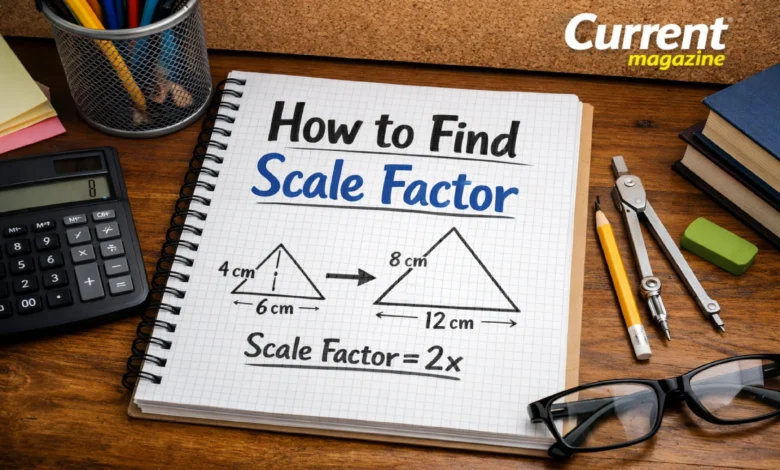
Learning how to find scale factor is an essential math skill that you’ll use in geometry, architecture, map reading, and even everyday situations like resizing photos or building models. A scale factor is simply the ratio that describes how much a figure has been enlarged or reduced compared to its original size. Whether you’re working on homework, creating a blueprint, or trying to understand map distances, this complete guide will teach you everything you need to know about finding and using scale factors with confidence.
What is a Scale Factor?
A scale factor is a number that scales, or multiplies, a quantity. In geometry and mathematics, it tells you how many times larger or smaller a new figure is compared to the original figure.
For example, if you have a square with sides of 2 inches and you create a larger square with sides of 6 inches, the scale factor is 3 because each side has been multiplied by 3.
Scale factors can be:
- Greater than 1 – This means the figure is being enlarged (made bigger)
- Less than 1 – This means the figure is being reduced (made smaller)
- Equal to 1 – This means the figure stays the same size
Why Scale Factors Matter
Understanding scale factors is important for many real-world applications:
Architecture and construction – Architects use scale factors to create blueprints that represent actual buildings at a manageable size on paper.
Map reading – Maps use scale factors to represent large distances in a small space. A map might show that 1 inch equals 100 miles.
Photography and design – When you resize an image while keeping its proportions, you’re using a scale factor.
Model building – Model trains, cars, and buildings are all created using specific scale factors like 1:50 or 1:100.
Engineering – Engineers use scale factors to create prototypes and test designs before building full-size versions.
Basic Formula for Finding Scale Factor
The basic formula for finding scale factor is:
Scale Factor = New Size ÷ Original Size
Or, written another way:
Scale Factor = Dimension of Scaled Figure ÷ Dimension of Original Figure
This formula works for any corresponding measurements – lengths, widths, heights, or even areas and volumes (with some adjustments).
How to Find Scale Factor: Step-by-Step Methods
Method 1: Finding Scale Factor from Two Measurements
This is the most straightforward method when you have measurements from both the original and the scaled figure.
Step 1: Identify a measurement from the original figure (like length, width, or height).
Step 2: Find the corresponding measurement on the scaled figure.
Step 3: Divide the scaled measurement by the original measurement.
Example:
- Original rectangle length: 4 cm
- Scaled rectangle length: 12 cm
- Scale factor = 12 ÷ 4 = 3
The scale factor is 3, meaning the figure has been enlarged to 3 times its original size.
Method 2: Finding Scale Factor from Similar Figures
When working with similar figures (shapes that have the same angles but different sizes), you can use any pair of corresponding sides.
Step 1: Identify two similar figures.
Step 2: Choose any side from the original figure.
Step 3: Find the corresponding side on the similar figure.
Step 4: Divide the length of the side from the similar figure by the length of the corresponding side from the original figure.
Example:
- Original triangle has a base of 5 inches
- Similar triangle has a base of 15 inches
- Scale factor = 15 ÷ 5 = 3
All sides of the similar triangle will be 3 times larger than the original.
Method 3: Finding Scale Factor from Area
When you know the areas of two similar figures, finding the scale factor requires an extra step because area is two-dimensional.
Step 1: Find the ratio of the areas: New Area ÷ Original Area
Step 2: Take the square root of this ratio.
Formula: Scale Factor = √(New Area ÷ Original Area)
Example:
- Original square area: 16 square feet
- Scaled square area: 64 square feet
- Area ratio = 64 ÷ 16 = 4
- Scale factor = √4 = 2
The sides of the scaled square are 2 times longer than the original.
Method 4: Finding Scale Factor from Volume
For three-dimensional figures, when you know volumes, you need to take the cube root.
Step 1: Find the ratio of the volumes: New Volume ÷ Original Volume
Step 2: Take the cube root of this ratio.
Formula: Scale Factor = ∛(New Volume ÷ Original Volume)
Example:
- Original cube volume: 8 cubic inches
- Scaled cube volume: 64 cubic inches
- Volume ratio = 64 ÷ 8 = 8
- Scale factor = ∛8 = 2
The edges of the scaled cube are 2 times longer than the original.
Method 5: Finding Scale Factor from a Scale Ratio
Maps and blueprints often give you a scale ratio like 1:100 or 1 inch = 50 miles.
For ratio format (1:100): The scale factor is the second number divided by the first.
- Scale 1:100 means scale factor = 100 ÷ 1 = 100
- The actual object is 100 times larger than the drawing
For unit format (1 inch = 50 miles): Convert to the same units, then find the ratio.
- 1 inch = 50 miles
- 1 inch = 50 × 63,360 inches (there are 63,360 inches in a mile)
- 1 inch = 3,168,000 inches
- Scale factor = 3,168,000
Working with Different Types of Scale Factors
Enlargement (Scale Factor > 1)
When the scale factor is greater than 1, the figure is getting bigger.
Example: A photo is 3 inches wide. You enlarge it with a scale factor of 4.
- New width = 3 × 4 = 12 inches
- The photo is now 4 times larger
Reduction (Scale Factor < 1)
When the scale factor is between 0 and 1, the figure is getting smaller.
Example: A blueprint needs to show a 20-foot wall on paper. Using a scale factor of 1/48:
- Paper length = 20 × (1/48) = 20/48 = 0.417 feet = 5 inches
- The drawing is 1/48th the size of the actual wall
Fractional Scale Factors
Scale factors can be written as fractions, decimals, or whole numbers.
- Scale factor of 1/2 = 0.5 = the figure is reduced to half its size
- Scale factor of 3/4 = 0.75 = the figure is reduced to three-quarters its size
- Scale factor of 5/2 = 2.5 = the figure is enlarged to two and a half times its size
Practical Examples of Finding Scale Factor
Example 1: Model Car
A real car is 15 feet long. A model of the car is 5 inches long. What is the scale factor?
Step 1: Convert to the same units.
- 15 feet = 15 × 12 = 180 inches
Step 2: Apply the formula.
- Scale factor = Model ÷ Real = 5 ÷ 180 = 1/36
The model is built at a scale factor of 1/36, often written as 1:36 scale.
Example 2: Photograph Enlargement
You have a 4 × 6 inch photo that you want to enlarge to 12 × 18 inches. What’s the scale factor?
Step 1: Choose one dimension (let’s use width).
- Original: 4 inches
- New: 12 inches
Step 2: Calculate scale factor.
- Scale factor = 12 ÷ 4 = 3
You’re enlarging the photo by a scale factor of 3.
Example 3: Map Distance
On a map with scale 1:50,000, two cities are 8 cm apart. What’s the actual distance?
Step 1: The scale factor is 50,000 (the map is 50,000 times smaller than reality).
Step 2: Multiply the map distance by the scale factor.
- Actual distance = 8 cm × 50,000 = 400,000 cm = 4,000 meters = 4 km
The cities are actually 4 kilometers apart.
Example 4: Garden Design
You’re designing a rectangular garden that’s 20 feet by 30 feet. You want to draw it on paper where 1 inch represents 5 feet. What will the dimensions be on paper?
Step 1: The scale factor from real to paper is 1/5 (or 0.2).
Step 2: Multiply each dimension by the scale factor.
- Length on paper = 20 × (1/5) = 4 inches
- Width on paper = 30 × (1/5) = 6 inches
Your drawing will be 4 inches by 6 inches.
Tips for Finding Scale Factor Accurately
Always use corresponding measurements – Make sure you’re comparing the same parts of each figure (length to length, width to width, etc.).
Keep units consistent – Convert all measurements to the same units before calculating. Don’t compare inches to feet or centimeters to meters.
Write it as a simplified fraction – Scale factors like 12/4 should be simplified to 3/1 or just 3.
Check your answer – Multiply the original measurement by your scale factor. You should get the new measurement.
Remember the order – Scale factor is always New ÷ Original, not the other way around.
Label clearly – When working with scale, always note what your measurements represent to avoid confusion.
Common Mistakes to Avoid
Dividing in the wrong order – Remember: scale factor = new size ÷ original size. Flipping this gives you the wrong answer.
Forgetting to convert units – Always use the same units for both measurements.
Confusing scale factor with scale ratio – A scale of 1:50 means the scale factor is 50 (or 1/50 depending on which direction you’re calculating).
Using different sides – When finding scale factor from similar figures, make sure you’re using corresponding sides, not random ones.
Forgetting square/cube roots – When working with area, take the square root. When working with volume, take the cube root.
Assuming all dimensions change – Make sure the figure is actually scaled proportionally. Sometimes only one dimension changes, which isn’t true scaling.
Using Scale Factor to Find Missing Measurements
Once you know the scale factor, you can find any missing measurement on either figure.
To find a measurement on the scaled figure: New measurement = Original measurement × Scale factor
To find a measurement on the original figure: Original measurement = New measurement ÷ Scale factor
Example: If a rectangle is scaled by a factor of 3, and the original width is 7 cm:
- New width = 7 × 3 = 21 cm
If the scaled length is 24 cm:
- Original length = 24 ÷ 3 = 8 cm
Scale Factor in Coordinate Geometry
When figures are drawn on a coordinate plane, you can find the scale factor by comparing the coordinates of corresponding points.
Step 1: Identify corresponding points on both figures.
Step 2: Calculate the distance from the origin (or center of dilation) to each point.
Step 3: Divide the new distance by the original distance.
Example:
- Original point: (2, 3)
- Scaled point: (6, 9)
- Distance from origin to original = √(2² + 3²) = √13
- Distance from origin to scaled = √(6² + 9²) = √117 = 3√13
- Scale factor = 3√13 ÷ √13 = 3
Or more simply, you can compare individual coordinates:
- x-coordinate: 6 ÷ 2 = 3
- y-coordinate: 9 ÷ 3 = 3
- Scale factor = 3
Final Thoughts
Finding scale factor is a valuable skill that connects mathematics to real-world applications. Whether you’re working with geometric figures, reading maps, or creating scaled drawings, the basic principle remains the same: divide the new size by the original size.
Start with simple problems using whole numbers, then work your way up to more complex scenarios with fractions, areas, and volumes. With practice, finding scale factors will become second nature, and you’ll start noticing scaled representations everywhere in daily life.
Remember to always check your work, keep your units consistent, and make sure you’re comparing corresponding parts of similar figures. Master these basics, and you’ll be ready to tackle any scale factor problem that comes your way!
10 Frequently Asked Questions About Scale Factor
- What’s the difference between scale factor and scale ratio?
Scale factor is a single number that tells you how many times bigger or smaller something is (like 3 or 0.5). Scale ratio is written as two numbers separated by a colon, like 1:100 or 1:50. To convert a scale ratio to scale factor, divide the second number by the first. For example, 1:50 means a scale factor of 50 (the real object is 50 times larger) or 1/50 (the model is 1/50th the size). - Can a scale factor be negative?
No, scale factors cannot be negative in standard geometry. Scale factors represent how many times larger or smaller something is, which is always a positive value. A scale factor of -2 doesn’t make sense because you can’t make something “negative 2 times” bigger. However, in coordinate transformations, negative values can indicate reflections, but that’s a different concept. - How do you find the scale factor if you only know the perimeter or area?
If you know the perimeters of two similar figures, divide the new perimeter by the original perimeter just like you would with any side length. For areas, you need to find the ratio of areas and then take the square root, because area is two-dimensional: scale factor = √(new area ÷ original area). - What happens to area when you apply a scale factor?
When you scale a figure by a scale factor of k, the area is multiplied by k². For example, if you double all the sides of a rectangle (scale factor = 2), the area becomes 4 times larger (2² = 4). If you triple the sides (scale factor = 3), the area becomes 9 times larger (3² = 9). - Is scale factor the same as zoom?
Yes, essentially! When you zoom in or out on a digital image, you’re applying a scale factor. Zoom at 200% means a scale factor of 2 (everything is twice as large). Zoom at 50% means a scale factor of 0.5 (everything is half the size). The image maintains its proportions because all dimensions are scaled by the same factor. - How do you find scale factor between two similar triangles?
Choose any pair of corresponding sides from the two triangles and divide the length of the side from the larger triangle by the length of the corresponding side from the smaller triangle. Since the triangles are similar, all pairs of corresponding sides will give you the same scale factor. You can verify by checking another pair of sides. - What’s the scale factor of an actual size drawing?
An actual size drawing (also called “full scale” or “1:1 scale”) has a scale factor of 1. This means the drawing is exactly the same size as the real object. Every measurement on the drawing equals the corresponding measurement on the actual object. - Can you find scale factor from angles?
No, you cannot find scale factor from angles alone. When figures are similar, corresponding angles are equal regardless of the scale factor. You must use the lengths of corresponding sides to find the scale factor. Angles tell you the shapes are similar, but sides tell you how much bigger or smaller one is than the other. - How does scale factor relate to model scales like 1:64 or HO scale?
Model scales like 1:64 (common for diecast cars) mean the model is 1/64th the size of the real object, so the scale factor is 1/64 or approximately 0.0156. HO scale (common for model trains) is 1:87, meaning scale factor = 1/87. To find the actual size, you multiply the model’s measurement by the second number (64 or 87). - What’s the easiest way to check if my scale factor is correct?
Multiply one measurement from the original figure by your scale factor – you should get the corresponding measurement from the scaled figure. For example, if the original length is 5 cm, your scale factor is 3, then 5 × 3 = 15 cm should be the new length. If it doesn’t match, recheck your calculation. This works in reverse too: divide a scaled measurement by the scale factor to get back to the original.